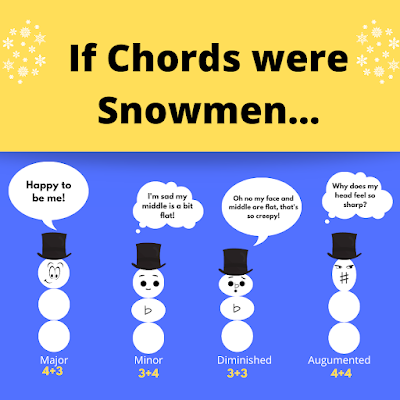
A picture is worth a thousand words... at least if you are a visual learner like me! This poster for teaching chord qualities in my music studio makes the differences between chords stand out a bit more.
We've been playing several games this past month to review the half step patterns in chords. At first glance when students see 3 skipping notes on the piano, it may look like the notes are the same distance apart, but counting the half steps between the keys helps them determine the chord quality.
Major (4+3),
Minor (3+4),
Diminished (3+3)
Augmented (4+4).
Hearing Chord Qualities
Chords have a distinct sound or mood.
Major sounds Happy
Minor sounds Sad or Spooky
Diminished sounds Creepy because of the "devil's interval" or tritone
Augmented sounds Tense or Suspenseful
Ear Training Activity: Snowman Interval
Listen to the root chord played by your teacher (or on teoria) and strike a pose for the chord you heard.
Major=Stand Up Happily
Minor-Crouch Down with a Sad Face
Diminished - Melt to the Ground
Augmented - Stand on Your Tippy Toes with a Crazy Face
More Online Chord ID Practice
For more practice hearing and identifying chords choose from the following activities on teoria.com
V7 chords can be a bit tricky for students because they are often introduced in many different ways. Most method books start with an easier first inversion of V7 chords that omits a few chord tones for easier playing.
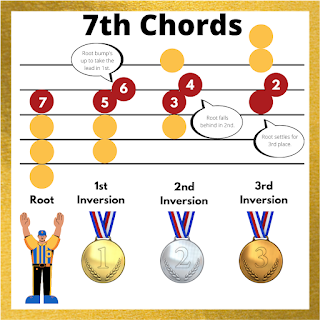
This 7th chord poster makes it easier to spot the roots and intervals to identify 7th chords and their inversions.
Quick Tips for Identifying V7 Chords
Look for the interval of the 2nd. My teacher always called these the "bumps" because one note is bumped to the side. The top "bump" is the letter name or root of the chord.
To identify the inversion, imagine the notes are running a race to the top of the staff.
In first inversion the "root bump" is in 1st place.
For 2nd inversion the "bump" falls to 2nd place.
For 3rd inversion the "bump" is in 3rd place.
V7 chords are often followed by a I chord in music. The interval of a 2nd in the V7 chord provides the tension and I chord feels like you are returning home to peace.
V7-Root Position 7th Chord
7th chords can also be identified by the intervals of the "bump notes."
7th chords in root position are easy to spot because they look like a tall snowman with four snowballs instead of the three you see stacked up in a triad. The root is on the bottom and with the highest note a 7th above it.
V6/5-1st Inversion 7th Chord
The root jumps up to the top of the chord in first inversion.
The resulting intervals are a 3rd, 5th and 6th.
The abbreviated chord symbol is V6/5
V4/3-2nd Inversion 7th Chord
Intervals above the lowest note include a 3rd, 4th and 6th.
The abbreviated chord symbol is V4/3
V2-3rd Inversion 7th Chord
Intervals above the lowest note include a 2nd, 4th and 6th
The abbreviated chord symbol is V2
Additional Resources for Learning About 7th chords
This month I'm challenging my piano students to learn a song to accompany their peers with at our December group lesson. Accompanying takes piano playing to the next level because students must play with continuity (no starting and stopping).
Piano Maestro Christmas Songs for Accompanying
The Piano Maestro app is an excellent tool to promote accompanist skills.
It gives automatic feedback for note accuracy as incorrectly played notes turn red.
It gives feedback about rhythmic accuracy.
The scrolling music forces you to continually look ahead in the music.
Some music focuses on the harmony instead of melody so you can't just lean on your ear to pick out the music. This also promotes audiation for students.
The practice mode allows students to practice in smaller phrases and isolate left or right hand parts for more focused practice sessions.
The instrumental backing tracks make music more enjoyable to play.
While the scrolling music feature is great for continuity, faster pieces may be easier to learn at first with printable music. Click this link to access free printable Christmas sheet music that you can also play on the Piano Maestro App. The tips below help you play with more expression instead of robotic feel.
Piano Practice Tips
Greensleeves (What Child is This) Elementary Harmony Only
Can you sing the melody as you play the harmony?
Greensleeves (What Child is This) Intermediate Hands Together
Color the melody notes red and harmony notes yellow. Notice the melody switches between the left and right hand frequently.
Playing music from a lead sheet opens up a new world of possibilities so that you can make familiar tunes have their own special flare.
Free Christmas Lead Sheets
These free Christmas lead sheets from Michael Kravchuk allow pianists to practice chords or prep to accompany a Christmas sing a long. Starting with the key of C is definitely easier for a beginner pianist, but playing in other keys can sometimes make it easier to sing along. Here are a few familiar favorites I like to star with but there are over 30 to choose from on MichaelKravchuk.com with options to select from multiple keys for each song.
Choose at least 6 pieces to listen to. Write the name of the piece, then click the link to hear it and answer the following questions on your Festival Samples Listening Assignment Sheet:
Every year I love to revisit student favorite Halloween Piano Resources. I was delighted today to discover and add several new spooky composing and improvisation resources to the list that I am eager to try out with my students.
Halloween Piano Composing Printables
Teach Piano Today just posted this Mummy Music Free Printable that is a perfect quick win for beginning students. It centers around middle C hands separate. I love how students can gain confidence composing by just having to create a short motif to "fill in the blanks." Its the perfect activity for hesitant composers because of the guided process.
Halloween Piano Improvisation Tutorial Videos
I love these leveled tutorial videos for creating spooky music at rebeccaspianokeys.com for more experienced elementary, intermediate or advanced students. They are perfect for piano lab or at home exploration because Rebecca gives specific step by step tips and instructions for success with musical samples throughout.
Level 1 introduces interval qualities including minor and tritones to be used in a hands separate "conversation" style spooky improv.
Level 2 includes more hands together playing including minor alberti bass style chords.
Level 3 describes the process of adding more expressive details including dynamics, tempo changes, pitch, etc.
Although Forrest Kinney's Create First Improvisation was not created specifically for Halloween, these improvisation video can be used to create music with a spooky Halloween flavor.
Two important skills for reading new music quickly include identifying notes and intervals with speed and accuracy. This month's group lesson focus and piano studio challenge is for student's to level up their note naming and/or interval id skills by earning a new 60 second challenge badge.
In addition to practicing with TonicTutor.com or racing to say and play the note naming sheets in their folders, students can try some of these online games to sharpen their skills.