Being able to quickly identify and play chords is a fundamental skill that is used over and over in piano playing.
I shared this Crazy Chord Challenge a few years ago. It is one of the options for the Keyboard Skills Challenge. This updated post includes some video samples. Students can choose the pace they want to play as long as they complete each challenge in less than a minute.
To prep them for the challenge, I demonstrate while chanting the chord categories as I play. "Va-ni-lla (C), "Or-e-o" (Db), "Ham-bur-ger" (D), etc.). Being able to see the color patterns on the keyboard and feel them under their fingers quickly really boosts the ease of playing chords from written notation later on.
Can you play all of the Major chords Block Style Hands Together (Left than Right), Moving Chromatically Down the Keyboard in Less than 1 Minute?
Challenge 7
Can you play one of the above challenges but using Minor Chords instead?
Hint: move your 3rd finger one note to the left (flat)
Challenge 8
Can you play one of the above challenges with Eyes Closed?
For a more difficult challenge, students who have already mastered root chords could play inversions or I-IV-I-V-I chord progressions with a longer time limit!
December is the month for the arpeggio challenge in my piano studio. They say a picture is worth a thousand words, so canva comes in handy to compensate for my lack of artistic skills!
I love to create visuals to post on my bulleting board to make the learning more memorable and pique the interest of students as they come each week.
This post includes resources that I mentioned in my presentation at UVMTA about flipped learning in the music studio.
Click the image above to view the slideshow presentation for UVMTA on flipped learning in the music classroom, which includes hyperlinks or browse some of the resources that were mentioned below.
"Tell me and I forget, teach me and I remember, involve me and I learn."
Sing the melody as you play just the root notes with your left hand. Choose the octave you prefer. For example, does High G or Low G sound better? Which is easiest to play? Could you play both at the same time or alternate to make it more lively?
Level 2- Left Hand Root Position Chord
Play the chords in root position (stacked up like a snowman) as you move your hand like a cookie cutter to the different chords.
G=GBD C=CEG Em=EGB D=DF#A
Late Elementary
Level 3- Left Hand Chord Inversion
Jumping around between root chords can be tricky! If you change the order of the notes (invert), it can make it easier to switch between chords. GBD to CEG is a big leap, but if you play GBD and GCE instead you can feel the stretch up without having to look at your fingers.
Play the right-hand melody along with left-hand chord progressions. You can substitute minor chords for major chords you are more familiar with playing or add Sus chords.
Experiment with chords that share some of the same chord tones. For example, in the key of C, the D minor (ii) chord D-F-A could be replaced with the more familiar F Major (IV) chord F-A-C because both include F and A.
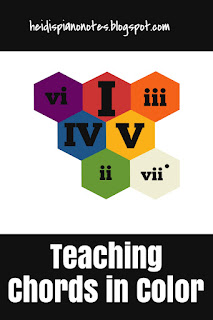
Substitutes for Red (I) are Purple (vi) and Orange (iii)
Substitutes for Blue (IV) is (ii) Green and Purple (vi)
Substitute for Yellow (V) is Orange (iii) or (vii) or (V7)
Practicing the piano with specific goals in mind is significantly more effective than simply measuring the time spent and calling it good. This month, for my studio challenge, I'm inviting students to level up their practice by using focused practice strategy games during their practice. Obviously, effective practice includes spending time at the piano bench, but practicing with purpose not only helps the time pass quickly, it also helps students to be more productive so that progress happens in less time.
Gamified Piano Practice
I've seen the power of gamified practice during piano lab, where students just don't want to stop their practice until they've completed the next level of Rhythm Swing or earned 3 stars to unlock the next level on Piano Maestro. That same excitement of flow and achievement that comes from video games and music apps can also happen on the bench when students approach learning new pieces with gamified strategies using practice game cards.
As a college student, my practice was definitely more focused and enjoyable when I paired it with chocolate chips and "3 in a Row" (or Cross the River) practice.
Boss Mode Practice
Overall piano practice success can also be compared to video game levels. I love this analogy shared by Nicola Cantan at the recent Piano Teacher Turboboost I attended!
Level 0 -Tutorial Mode (No Practice)
Level 1 - 1-3 Days per Week
Level 2 - 4-6 Days per Week
Level 3 - Add 3x Repetitions to your Level 2 Practice
Level 4 - Use practice card strategies for Focused Practice Sessions
Level 5 - BOSS MODE - Pair clear and specific goals with your practice card games and record your progress for each practice session.
While we might not achieve BOSS MODE every week, TUTORIAL MODE can kill the fun if students are stuck in it week after week.
The challenge goal is to look at what level you are currently practicing at and make personal improvements to LEVEL UP!
This month at group lessons we will focus on sight reading strategies For the studio challenge, I invite students to level up their sight-reading skills by choosing a challenge to complete below.
Sight Reading Challenges
New Beginners: 90% Piano Key Names on Tonic Tutor & Flashnote Derby Landmarks
Then choose your favorite style, follow the 3 boundary rules, and improvise your own short Halloween piece during piano lab. Choose a fun title that matches the mood of your piece.
This month my piano students will be completing an Arpeggio Challenge to boost their skills and understanding of this fundamental pattern that comes up in music over and over.
While prepping for our piano arpeggio-themed group lesson I discovered some new arpeggio resources and revisited some of my favorites from the past.